AI engineering · Open engineering software
Engineeringintelligence.Software freedom.
Pack-Mind builds CATE, the AI engineering platform for industrial machinery, and develops tailored open-source engineering software for the companies that design and build machines.
- Built for machine builders and OEMs
- CATE — AI engineering with engineer-in-the-loop validation
- Open Engineering — open-source software you control
- Cognitive Assistant for Technical Engineering
- Built for machine builders
- PLC · HMI · CAD · Motion · Electrical
- One shared engineering context
- From concept to after sales
Pack-Mind — two engineering practices
Packaging Valley
Built for the Engineering Challenges of Packaging Valley.
Tailored engineering software for machinery manufacturers, automation specialists and industrial design teams.
An automatic machine is an assembly of handling groups, mechanical transmissions, grippers, guides and conveying systems — designed in variants, order after order. Pack-Mind, registered in Granarolo dell'Emilia (Bologna), builds its software practice around that way of engineering, starting from the Emilian district of automatic machines.
- Automatic machine builders
- Packaging machinery manufacturers
- Mechanical design offices
- Industrial automation companies
- R&D departments
- System integrators
- Assemblies
- Product structure
- Bill of materials
- ERP / PDM
Procedural concept visualization — not the drawing of an existing machine. Drag to orbit.
What is CATE
CATE — Cognitive Assistant for Technical Engineering.
CATE is an AI engineering platform designed to assist, automate and coordinate the complete technical development lifecycle of industrial machinery. Not a chatbot, not a coding assistant: a system that works across the disciplines of the technical office, on one shared engineering context.
Engineering capabilities
Every discipline of the technical office. One engineering system.
CATE assists, automates and coordinates the main technical disciplines involved in the development of an industrial machine.
PLC Engineering
AI-assisted generation and iteration of industrial control software: machine sequences, state machines, alarms, interlocks and reusable modules — validated by your engineers.
HMI Engineering
Generate screens, navigation, alarms and diagnostics from machine logic — designed to stay coherent with the PLC structure, not disconnected from it.
Mechanical CAD
Assist and automate 2D and 3D mechanical workflows: components, assemblies, design alternatives and repetitive design tasks.
Motion & Simulation
Iteratively refine motion profiles, kinematics and cycle time — and feed simulation results back into mechanical and software design.
Electrical Engineering
Generate schematics, I/O mapping, terminal diagrams and hardware documentation from the machine architecture and devices.
Technical Documentation
Produce functional specs, software documentation, alarm lists and manuals from the actual engineering context — not from isolated information.
Beyond engineering
After Sales
Machine knowledge becomes operational intelligence for support, troubleshooting and diagnostics.
Predictive Maintenance
Provides the intelligence layer required for predictive maintenance workflows, designed to evolve with machine data.
Engineering Orchestration
Specialized AI agents coordinated by CATE across a single, shared machine context.
Cross-domain engineering
Engineering disciplines should not work in silos.
A mechanical change can affect the motion profile, the PLC sequence, HMI diagnostics, the electrical design and the documentation. CATE coordinates these disciplines on the same machine context — so information propagates instead of getting lost.
- Mechanical geometry change
- → motion profile updated
- → PLC sequence revised
- → HMI diagnostics regenerated
- → electrical design checked
- → documentation refreshed
Engineering loop
Design. Simulate. Validate. Iterate.
CATE coordinates a digital-twin-like simulation loop between mechanical design, motion and software engineering: geometry feeds motion simulation, results feed back into design and PLC software, and every iteration moves the machine closer to a validated outcome.
- DESIGN
- SIMULATE
- ANALYZE
- FEEDBACK
- mechanical geometry···loaded
- motion law simulation···3 constraints detected
- feedback → mechanical design···geometry updated
- feedback → motion & PLC···profiles regenerated
- engineer validation···iteration 02 approved
Current CATE build
The platform is already taking shape.
CATE is being built as a unified engineering workspace where specialized AI agents, technical context and human validation come together across machine development. The workspace below is the current CATE frontend — under active development, iterating towards pilot deployments.
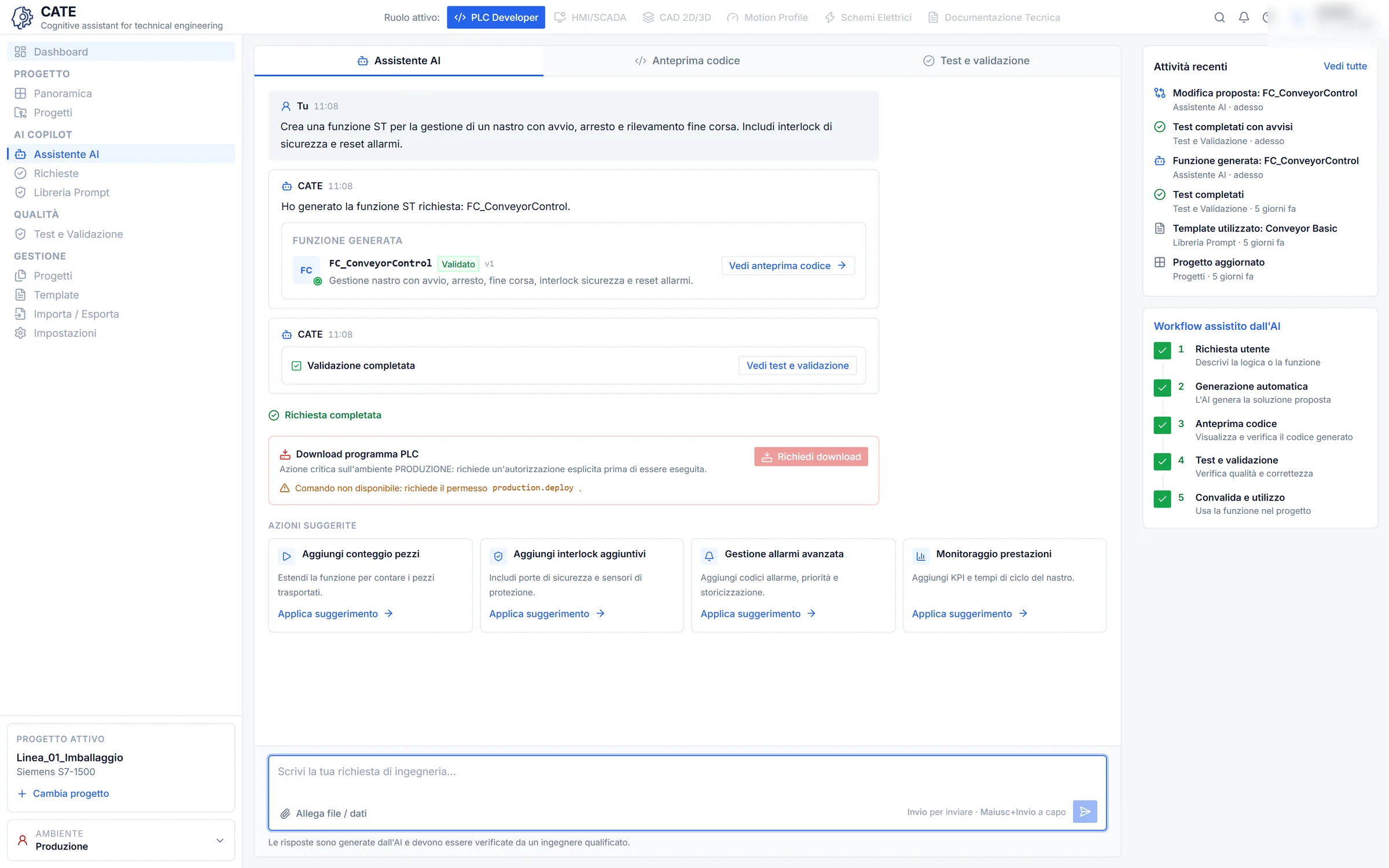
PLC · HMI · CAD · Motion · Electrical · Documentation
Already represented in the current build.
Early access coming soonHuman-in-the-loop
AI generates. Engineers validate. The system iterates.
CATE is not autonomous engineering. Every critical output — PLC code, schematics, motion laws, documentation — remains subject to engineer validation. Feedback and corrections become the next iteration.
- 01REQUESTMachine requirement
- 02AI ENGINEERINGCoordinated agents
- 03GENERATED OUTPUTCode · Schematics · Docs
- 04ENGINEER VALIDATIONReview · Correct · Guide
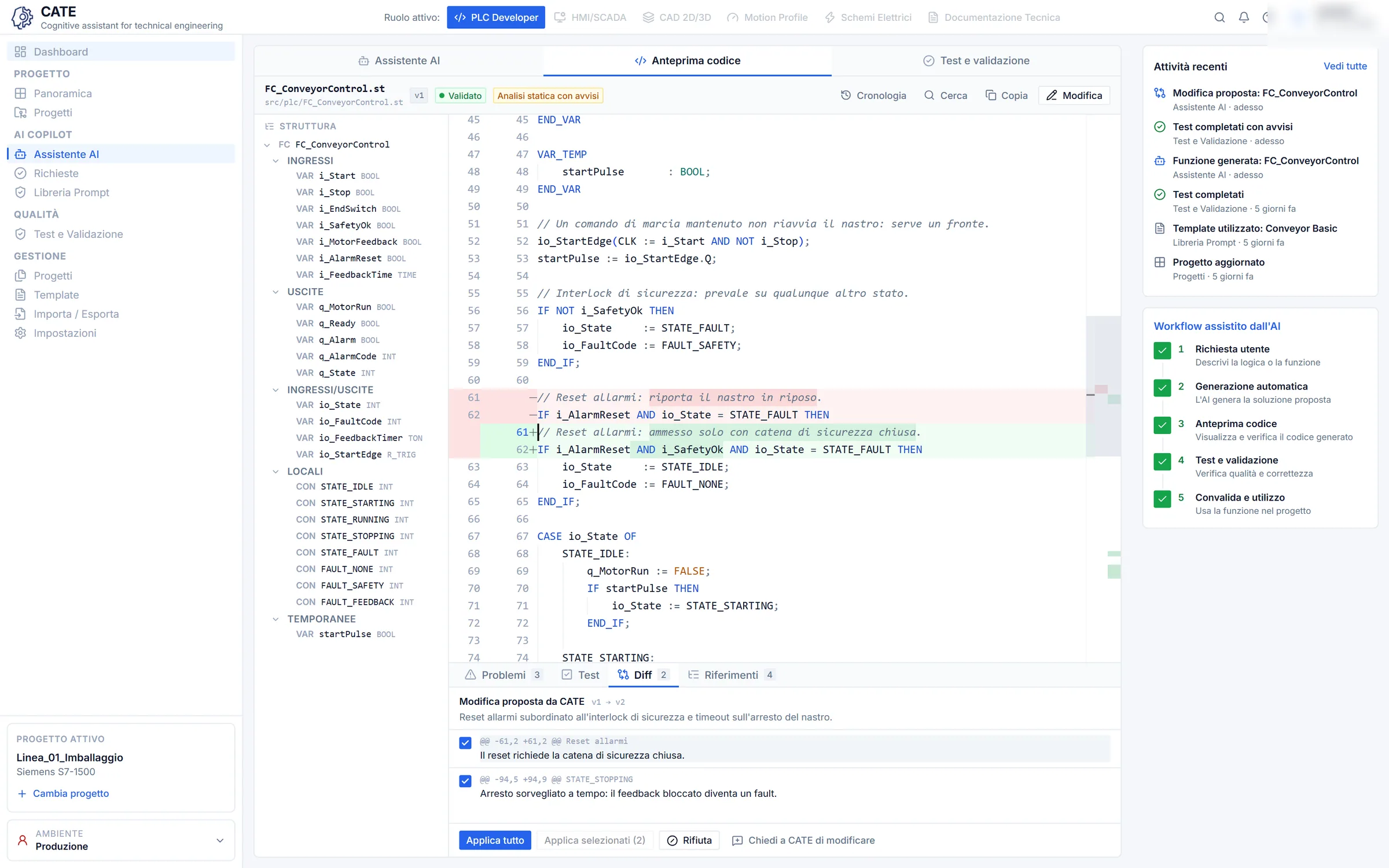
Every change is a reviewable proposal — apply, refine or send it back to CATE.
Validated output is released — code, schematics or documentation enter the machine engineering context.
Corrections and guidance become the next iteration — the system regenerates under engineer supervision.
Engineering surfaces
Real engineering. Real interface.
Specialized modules of the current CATE build: mechanical CAD and motion engineering on one shared machine context. The full cross-domain platform expands from here, discipline by discipline.
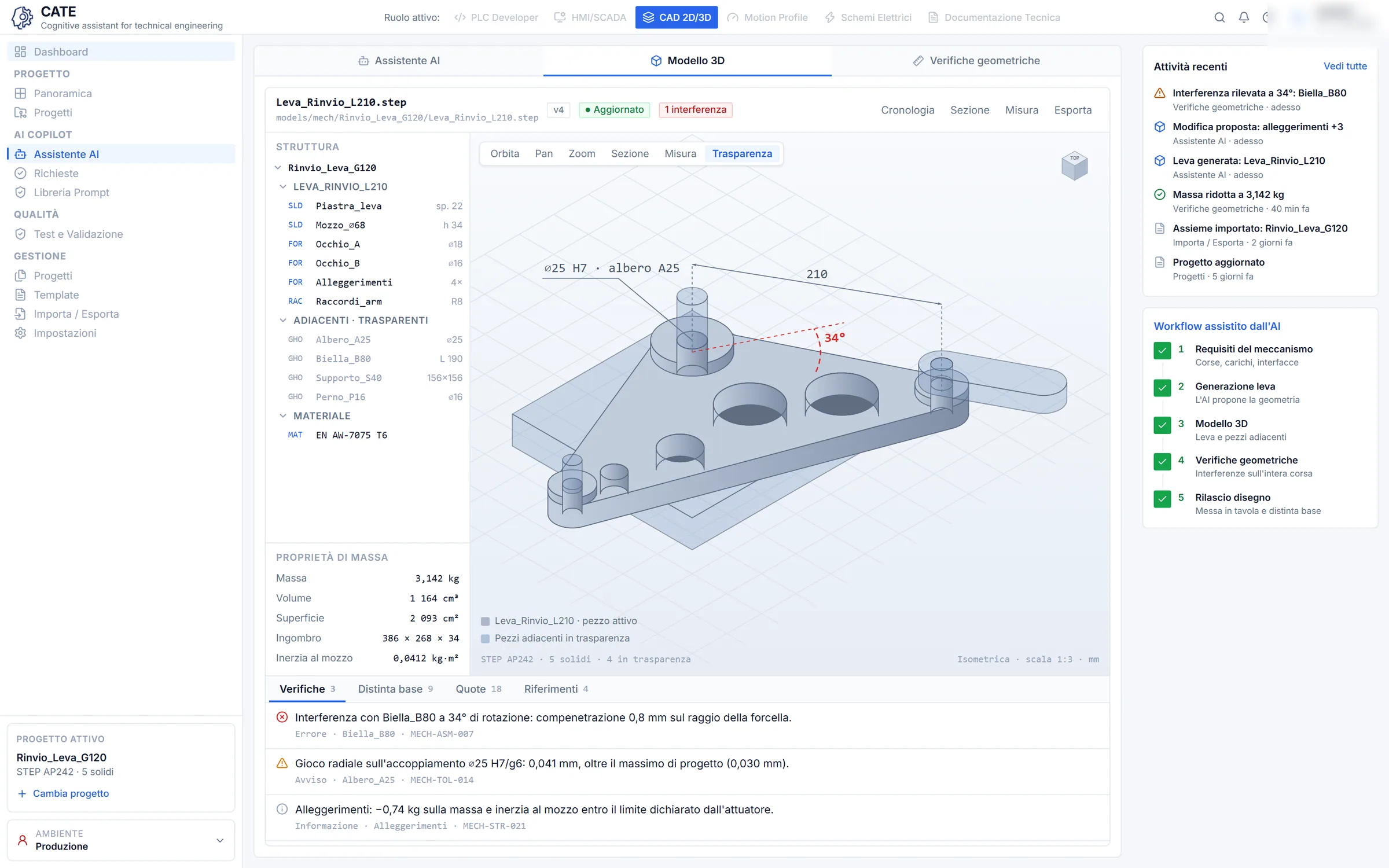
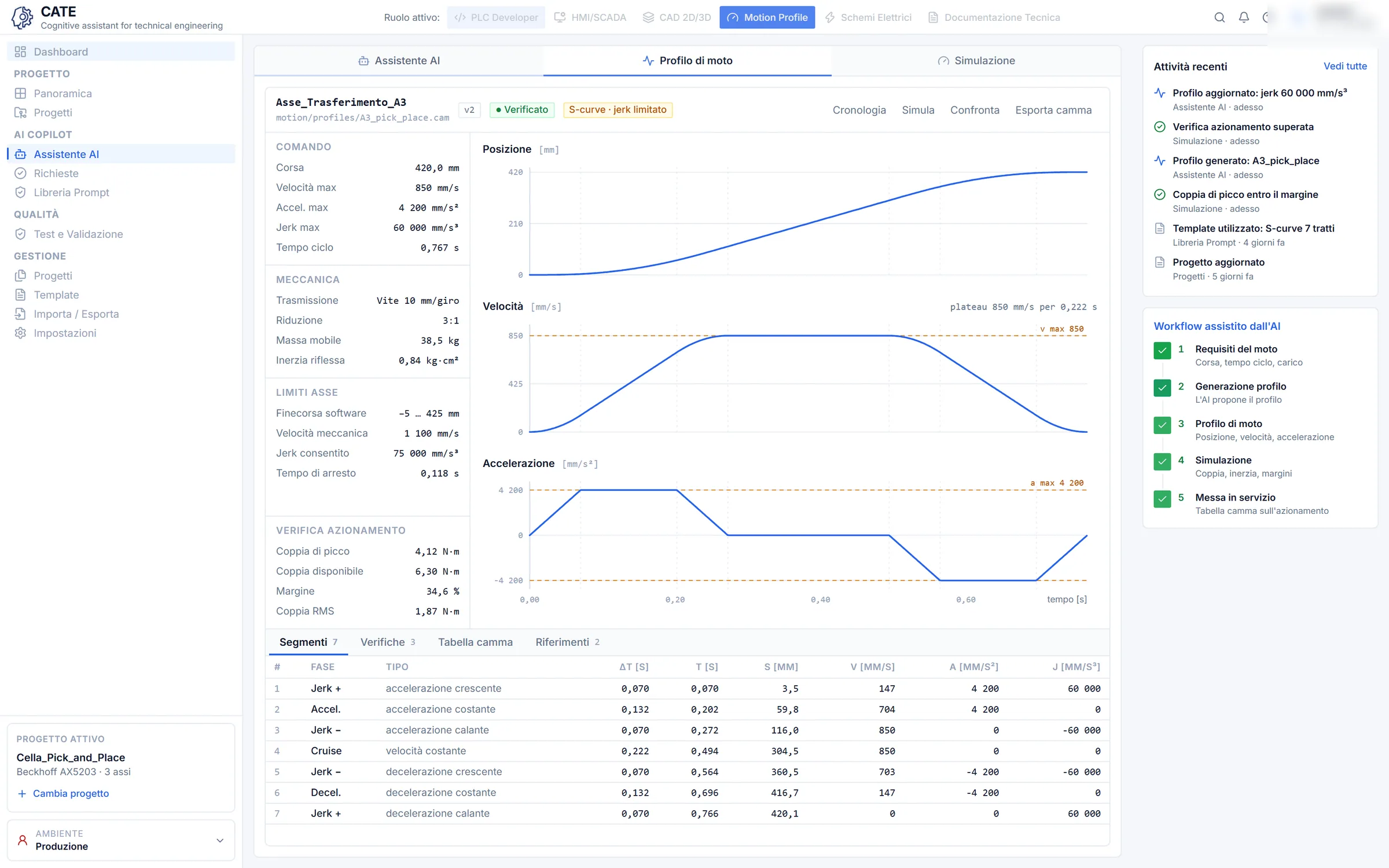
Current build: CAD & Motion modules — PLC, HMI, Electrical and Documentation in active development.
Machine lifecycle
One engineering intelligence. The entire machine lifecycle.
CATE accompanies the machine from first concept to operation. The engineering knowledge created during development becomes operational intelligence throughout the machine lifecycle.
CATE coordinates every stage on the same engineering context.
After sales & maintenance
The engineering knowledge keeps working after delivery.
The engineering context built during development — machine architecture, software, alarms, documentation — does not expire at commissioning. It supports the machine for its entire operational life.
Technical Support
Troubleshooting and diagnostics grounded in actual machine knowledge — not scattered documents.
Machine History
Software analysis, manual retrieval and configuration documentation, always traceable to the engineering context.
Maintenance Assistance
Diagnostics, condition analysis and maintenance records connected to the machine's design knowledge.
Predictive Maintenance
Designed to combine design knowledge, alarms, sensor and historical data to identify anomalies, degradation and failure patterns.
Technology
How CATE works.
Beneath the engineering surface: an agent control plane that coordinates specialized AI over your models, your tools, your simulation stack and your infrastructure.
Observability — audit · monitoring · engineer approvals
Security & Deployment
Your infrastructure. Your data. Your control.
CATE is designed to run inside your security perimeter — not around it.
Open Engineering Software
Own your engineering tools. Not your licensing constraints.
Alongside CATE, Pack-Mind runs a dedicated service line: custom engineering software built on open-source technologies — starting from CAD — integrated with your business systems and professionally maintained.
- Open CAD engineering: parametric modeling, assemblies, kinematics
- Integration with bills of materials, ERP, PDM and PLM
- Customization, managed maintenance and optional AI engineering services
An independent service line — not a CATE feature.
Get started
Engineering intelligence for your technical office.
CATE is under active development — pilot deployments in preparation.